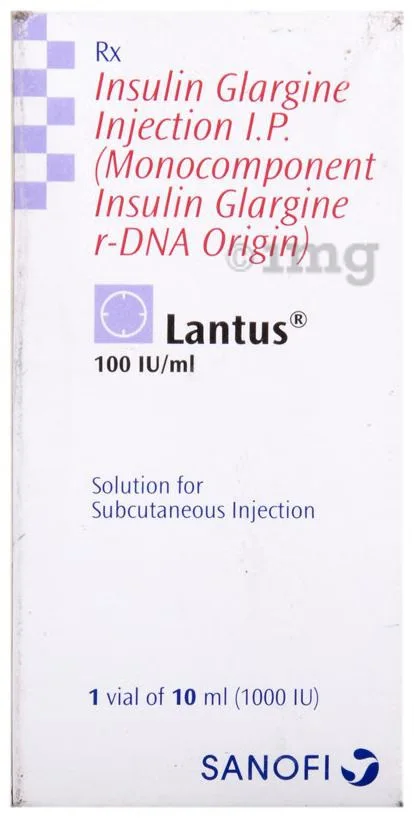
Lantus Insulin is a prescription-only insulin made of insulin glargine 100 IU/mL, a clear solution you inject under the skin once a day. It is used to treat diabetes mellitus in adults, adolescents and children aged 2 years and above. Never inject it into a vein, and do not use it if you are allergic to insulin glargine or its other ingredients.
Composion at a glance: Insulin glargine 100 IU/mL, a clear solution for subcutaneous injection
Marketer: Sanofi India Limited
Prescription: Prescription required
Key facts about Lantus Insulin
Lantus Insulin has one active ingredient, one strength and a few pack formats. The table below sums up what is on the label.
| Key fact | Details |
|---|---|
| Composition | Insulin glargine 100 IU/mL, a clear solution for subcutaneous injection |
| Strength, form and pack | Lantus SoloStar is a prefilled pen; the Indian abridged label also lists vials and cartridges (cartridges are used only with the specified reusable pens) · 3 mL prefilled SoloStar pen, 1 pen per pack |
| Marketer | Sanofi India Limited |
| Manufacturer | Sanofi-Aventis Deutschland GmbH, Frankfurt |
| Prescription status | Prescription required |
| Storage | Unopened vial or cartridge: store at 2–8°C until expiry (may be kept below 30°C for 28 days); do not freeze, discard if frozen; protect from heat and light. In-use SoloStar pen: keep at room temperature, not in the fridge, and discard 28 days after opening |
About Lantus Insulin
Lantus Insulin contains a single active ingredient, insulin glargine, at 100 IU in every mL. It is a clear, colourless solution meant only for injection under the skin.
You will usually see it as Lantus SoloStar, a prefilled pen. The Indian abridged label also lists vials and cartridges. The cartridges work only with the specified reusable pens, so they are not a swap-in for any pen you happen to have.
Each SoloStar pack holds one 3 mL prefilled pen. Lantus is marketed in India by Sanofi India Limited. The complete label is in the Sanofi India prescribing information for Lantus and Lantus SoloStar.
Uses of Lantus Insulin
Lantus Insulin is used to treat diabetes mellitus. The label covers these groups:
- Diabetes mellitus in adults, adolescents and children aged 2 years and above.
- Type 2 diabetes, where Lantus can be given together with oral antidiabetic medicines.
Lantus is not the insulin of choice for diabetic ketoacidosis, which is an emergency your doctor treats differently.
Benefits of Lantus Insulin
The practical benefit of Lantus Insulin is a simple routine: one injection under the skin, once a day. It can also sit alongside the tablets many people with type 2 diabetes already take.
One injection a day: You inject at the same time each day. The label allows any time of day, so you and your doctor can pick a time that suits your routine, and your doctor sets the dose and timing for you.
Works with oral medicines in type 2 diabetes: Lantus can be given together with oral antidiabetic medicines, so starting insulin does not always mean stopping your tablets. Your doctor decides the combination.
Approved across ages: The label covers adults, adolescents and children from 2 years of age.
Side effects of Lantus Insulin
The most frequent side effects of Lantus Insulin are low blood sugar when the dose is more than your body needs, and short-lived changes in vision. A few serious effects need help straight away.
- Hypoglycaemia (low blood sugar) if the dose is too high for your need, one of the most frequent effects.
- Temporary problems with vision, also among the most frequent effects.
- Lipodystrophy, a change in the fat under the skin where you inject.
- Redness, pain, itching, hives, swelling or inflammation at the injection site.
Get medical help right away if:
- You have severe low blood sugar. It can cause seizures, and severe cases can be fatal.
- You get a severe allergy affecting the whole body, including anaphylaxis. Lantus is stopped and the allergy is treated.
- Your blood potassium drops (hypokalaemia). Insulin moves potassium into cells, and untreated hypokalaemia can be fatal.
How to take Lantus Insulin
Use Lantus Insulin exactly as your doctor prescribes: once a day, under the skin, at the same time each day. These steps come from the label.
- Inject under the skin of the abdomen, thigh or upper arm (deltoid), and rotate sites within the area you choose. Do not inject into skin with lipodystrophy or localised amyloidosis.
- Do not mix Lantus with any other insulin, and do not dilute it.
- Check that the solution is clear and colourless. Do not use it if it is coloured, cloudy or has particles in it.
- Read the label before every injection. People have mixed up Lantus with short-acting insulins by accident.
- Inject once daily at the same time each day. Your doctor adjusts the dose and timing for you.
- If you are moving from insulin glargine 300 U/mL, the label advises starting at 80% of the previous dose to lower the risk of low blood sugar. Your doctor works out this switch.
Missed dose: Take it as soon as possible. If your next dose is near, skip the missed one.
Overdose: Mild low blood sugar can usually be treated with carbohydrate by mouth. Severe low blood sugar with coma, seizures or nerve-related symptoms may need glucagon or glucose into a vein, and low potassium must also be corrected.
Safety advice for Lantus Insulin
Most safety points for Lantus Insulin are about keeping your sugar steady in situations that can push it up or down. Here is what the label says for each.
Alcohol (Caution): Take care with alcohol while you are on Lantus Insulin. Alcohol may raise or lower the sugar-lowering effect of insulin, with a risk of hypoglycaemia.
Pregnancy (Safe if prescribed): Lantus Insulin can be used in pregnancy if it is clinically needed. Post-marketing data from over 1000 exposed pregnancies show no specific harmful effects on the baby before or after birth. Insulin needs may fall in the first trimester, rise in the second and third, and drop quickly after delivery, so your doctor will review your dose through each stage.
Breastfeeding (Consult your doctor): There is no or only limited data on insulin glargine in human milk. Talk to your doctor, who will weigh the benefits of breastfeeding against your need for Lantus.
Driving (Caution): Both low and high sugar can slow your concentration and reaction time.
Kidney (Caution): Kidney problems can lower how much insulin you need, and a steady decline in kidney function can keep lowering it. This also matters for older adults.
Liver (Caution): The effect of liver problems on how Lantus is handled in the body has not been studied. Frequent sugar checks and dose changes may be needed.
Who should not take Lantus Insulin
Lantus Insulin must not be used by anyone allergic to insulin glargine or any of its other ingredients. A few other situations also need extra care.
Allergy to insulin glargine: Do not use Lantus if you have ever reacted to insulin glargine or any ingredient in the pen, vial or cartridge.
Diabetic ketoacidosis: Lantus is not the insulin of choice for this emergency. Your doctor will decide the right treatment.
Mix-ups with fast-acting insulin: People have accidentally used a short-acting insulin in place of Lantus. Check the label every time before you inject.
Fever, infection or other illness: When you fall ill with something else, your sugar needs closer monitoring. Ketone checks and a change in dose are often needed, so tell your doctor early.
Carry carbohydrate: The label advises carrying at least 20 g of carbohydrate at all times, because low sugar can usually be corrected by eating it straight away.
Interactions with Lantus Insulin
Some medicines can hide the warning signs of low sugar, and others change how your body handles glucose. Share a full list of everything you take with your doctor.
- Beta-blockers, clonidine, guanethidine and reserpine: These may mask the signs of low blood sugar, so your sugar checks may need planning around them.
- Thiazolidinediones (TZDs): Taking a TZD with Lantus can cause fluid to build up in the body and can make heart failure worse.
- Other medicines that affect blood sugar: Certain drugs change glucose metabolism, and your Lantus dose may need adjusting.
The prescribing information lists interactions, so ask your doctor or pharmacist to check your medicines against it.
FAQs about Lantus Insulin
What is the Lantus Insulin price in India?
The price of Lantus Insulin varies from pharmacy to pharmacy and can change over time, so go by the current MRP printed on your pack and your bill.
Lantus Insulin aur Lantus injection mein kya fark hai?
There is no difference. Lantus Insulin, Lantus injection, inj Lantus and insulin Lantus are all names for the same medicine: insulin glargine 100 IU/mL, a clear solution injected under the skin. Only the format changes, between the SoloStar prefilled pen, vials and cartridges for the specified reusable pens.
Is there a Lantus tablet or syrup?
No. The label lists no tablet or syrup form. Lantus is only a solution for injection under the skin, supplied as the SoloStar prefilled pen, vials and cartridges. Tablets for diabetes are separate medicines, and in type 2 diabetes they may be used alongside Lantus if your doctor plans it.
What does Lantus Insulin 100 IU/mL contain and how should it look?
Each mL contains 100 IU of insulin glargine in a clear solution. Before every injection, take a quick look: it should be clear and colourless. If it looks coloured or cloudy, or you can see particles floating in it, do not use it. Set it aside and use another pen or vial.
How long can a Lantus pen stay out of the fridge?
Once you start a SoloStar pen, keep it at room temperature, not in the fridge, and throw it away 28 days after opening. Unopened vials and cartridges stay in the fridge at 2 to 8°C, or below 30°C for up to 28 days. Never freeze them, and keep them away from heat and light.
Lantus ka dose miss ho jaye toh kya karein?
Take the missed dose as soon as you remember. If your next dose is almost due, skip the missed one and carry on with your usual timing. Since Lantus is meant to be given at the same time each day, ask your doctor how close is too close for your own routine.
What should I do if my sugar goes low on Lantus Insulin?
Mild low sugar can usually be corrected by eating carbohydrate straight away, which is why the label advises carrying at least 20 g at all times. Glucagon or glucose into a vein may be needed, and low potassium is corrected too.
Can I switch from insulin glargine 300 U/mL to Lantus Insulin myself?
No. A switch is planned by your doctor. When moving from insulin glargine 300 U/mL to Lantus Insulin, the label advises starting at 80% of the previous dose to lower the risk of low blood sugar. Your doctor sets the exact number of units and how closely to watch your sugar afterwards.
Can a Lantus Insulin cartridge be used in any pen?
No. The Indian abridged label lists cartridges alongside vials and the SoloStar prefilled pen, but cartridges are used only with the specified reusable pens. A Lantus Insulin cartridge is not a swap-in for any pen you happen to have. Ask your doctor or pharmacist which pen matches your cartridge.
What is inj Lantus Insulin used for?
Inj Lantus Insulin is another name for Lantus Insulin, so it is used to treat diabetes mellitus in adults, adolescents and children aged 2 years and above. In type 2 diabetes it can be given together with oral antidiabetic medicines. It is not the insulin of choice for diabetic ketoacidosis. Your doctor decides the dose.
Lantus Insulin needle: what do I use with the pen?
Pen needles are sold separately from the pen, and only needles approved for use with the SoloSTAR pen should be used. Inject under the skin of the abdomen, thigh or upper arm and rotate sites. Never share a pen between patients, and check that the solution is clear and colourless before each injection.
References
- sanofi.com. sanofi.com. Accessed 3 Nov 2026
- campus.sanofi. campus.sanofi. Accessed 3 Nov 2026
- sanofi.com. sanofi.com. Accessed 3 Nov 2026 (sanofi.com)
- rxlist.com. rxlist.com. Accessed 3 Nov 2026
- products.sanofi.us. products.sanofi.us. Accessed 3 Nov 2026
- reference.medscape.com. reference.medscape.com. Accessed 3 Nov 2026
- campus.sanofi. campus.sanofi. Accessed 3 Nov 2026 (campus.sanofi)
- mayoclinic.org. mayoclinic.org. Accessed 3 Nov 2026
About this page
Written by: Mr. Neeraj Kumar, Bachelor’s Degree
Updated on: 3 Nov 2026
Product information: Product details come from the pack label, the manufacturer and published regulatory records, and are checked against the sources listed on this page before publishing. Read our editorial policy.
Disclaimer: Product information is provided for reference and does not replace advice from your doctor or pharmacist. Prescription medicines are supplied only against a valid prescription. Do not start, stop or change any medicine without medical advice. Prices and availability can change.
Marketer details: Marketed by Sanofi India Limited, manufactured by Sanofi-Aventis Deutschland GmbH, Frankfurt