Thiamine tablet uses centre on vitamin B1. The usual tablet holds 100 mg of thiamine hydrochloride and is taken to treat or prevent thiamine deficiency, to top up a diet low in B1, and to treat beriberi and Wernicke-Korsakoff syndrome. Do not take it if you have ever reacted to thiamine or any ingredient in the tablet.
Indian listings differ on whether you need a prescription, and no CDSCO statement on its schedule was found. Either way, the references advise taking it under a doctor's supervision.
Key facts about Thiamine Tablet
Here is the short version: one vitamin, one common strength, and a few storage basics to keep in mind.
| Key fact | Details |
|---|---|
| Strength and form | Listed in India as 100 mg. Other strengths seen are 50 mg and 75 mg. No source describes a 200 mg tablet; the 200 mg products found were injections |
| Pack sizes | 100 tablets, 10 x 10 strips and 10-tablet boxes |
| Brands in India | THIAMEAL ADD 100 (Steris Healthcare), THI-B1 (Johnlee) and Icon Pharmaceuticals products |
| Manufacturers | Trumac Healthcare makes thiamine 100 mg tablets under WHO-GMP-certified conditions for PCD franchise supply; Healthy Life Pharma also makes thiamine tablets (as stated on their own marketing pages) |
| Prescription status | Listings conflict: some show it as prescription-only, another as over the counter. No CDSCO statement on schedule was found |
| Storage | Room temperature (below 30 °C), dry, away from heat, moisture and light. Keep out of reach of children. Do not freeze |
| Shelf life | Listed as 24 months |
About Thiamine Tablet
Thiamine tablet is a single-ingredient vitamin B1 tablet, so it is not a combination product. You swallow it whole with water. It can be taken with or without food, and taking it with food can ease stomach irritation.
Most thiamine tablet uses relate to people who are more likely to run low on vitamin B1. These include:
- Older adults
- People who depend on alcohol
- People with HIV/AIDS or diabetes
- People with poor absorption from the gut
- People with a history of bariatric surgery
The dose and course length depend on why it is given, and the references do not agree. The full list is in the how-to-take section below. Your doctor will set the amount that suits you.
Uses of Thiamine Tablet
The main thiamine tablet uses are all linked to vitamin B1. It is used for:
- Treating or preventing vitamin B1 (thiamine) deficiency
- Supplementing your diet when food does not give you enough thiamine
- Beriberi
- Treating and preventing Wernicke-Korsakoff syndrome
- Thiamine-responsive genetic enzyme deficiency diseases
Benefits of Thiamine Tablet
The benefit of this supplement is simple: it gives your body vitamin B1 when it is short of it. Each of the thiamine tablet uses below has a defined purpose.
Low vitamin B1 levels: It supplies vitamin B1 when your body is short or your diet falls short. This is its main use.
Beriberi and Wernicke-Korsakoff syndrome: It is used to treat beriberi, and it is used to treat and prevent Wernicke-Korsakoff syndrome.
Rare inherited enzyme conditions: Some genetic enzyme deficiency diseases respond to thiamine. Here, the tablet is one part of a plan your specialist sets.
What thiamine is not proven for: Claims that thiamine helps skin problems, long-term diarrhoea, tiredness, mental problems, multiple sclerosis, nerve problems or ulcerative colitis have not been proven. We would rather you hear that plainly than buy a vitamin for the wrong reason.
Side effects of Thiamine Tablet
Thiamine tablet is generally well tolerated, and the common side effects involve the stomach. Allergic reactions are uncommon but need urgent care.
Common side effects:
- Nausea
- Vomiting
- Stomach upset
- Mild rash (rare)
Get medical help right away if: you get hives, rash, itching, trouble breathing, or swelling of the face, lips, tongue or throat. These are signs of an allergic reaction and need emergency help. Severe reactions (anaphylaxis) are reported mainly with thiamine injections, not tablets.
How to take Thiamine Tablet
Take thiamine tablets exactly as your doctor prescribes, and under a doctor's supervision rather than on your own.
- Swallow the tablet whole with water.
- Take it with or without food. With food, it may be gentler on your stomach.
- Stick to the dose and course your doctor gives you.
Doses listed in the references:
| Who | What the references list |
|---|---|
| Adults (deficiency) | One reference: 10 to 50 mg daily for 2 weeks, then 5 to 10 mg daily for 1 month |
| Adults (other references) | 100 to 300 mg daily in divided doses, or 100 mg once or twice daily |
| Infants | 0.3 to 0.5 mg once daily for supplementation |
| Children | 0.5 to 1 mg once daily for supplementation |
These figures differ, so they are not a dosing plan. A doctor decides the adult dose, and a healthcare provider decides the dose for children.
Missed dose: Take it as soon as you remember. If your next dose is almost due, skip the missed one and continue as usual. Do not double up.
Overdose: Get medical help or contact a Poison Control Center straight away. The gut absorbs only about 4 to 8 mg from a large oral dose.
Safety advice for Thiamine Tablet
Thiamine is a familiar vitamin, but a few situations call for a word with your doctor first. Here is what the references say.
Alcohol (consult your doctor): Tell your doctor if you drink alcohol. Low vitamin B1 is more common in people with alcohol dependence, which is one of the key thiamine tablet uses.
Pregnancy (consult your doctor): Thiamine is not expected to harm an unborn baby, but dose needs may differ in pregnancy. Avoid high doses unless prescribed. One reference advises not taking it without medical advice if you are pregnant or planning a pregnancy.
Breastfeeding (consult your doctor): Studies suggest minimal risk to the baby. Thiamine passes into breast milk, though references differ on this point.
Driving (not applicable): No statement on driving was found for thiamine HCl tablets.
Kidney disease (consult your doctor): If you are on dialysis, discuss your need for thiamine with your physician. If you have a kidney disorder, check with a healthcare provider before starting.
Liver disease (consult your doctor): Check with a healthcare provider before use.
Who should not take Thiamine Tablet
Do not take thiamine tablets if you have had an allergic reaction to thiamine or any ingredient in the tablet. Some other groups should check with a doctor or pharmacist first.
Allergy to thiamine: Avoid it completely.
Other illnesses, medicines or allergies: Speak to your doctor or pharmacist first if you have a medical condition, take other medicines or herbal products, have allergies, or have absorption problems.
Alcohol use, kidney disease, dialysis or liver disease: Mention these before starting, as covered in the safety advice above.
Pregnancy: Use only with medical advice, and avoid high doses unless prescribed.
Breastfeeding: Studies suggest minimal risk to the baby, but check with your doctor before use.
Children: References differ. One says it is safe with a dose set by a healthcare provider; another advises avoiding it under 12 years.
Before a blood test: Thiamine can give a false-positive uric acid result with the phosphotungstate method. Tell your doctor and the lab staff you take thiamine before any test.
Interactions with Thiamine Tablet
No severe interactions are known for thiamine, but mild interactions with many drugs are listed. Share your full medicine list with your doctor.
| Medicine | What can happen |
|---|---|
| Diuretics such as furosemide | Long-term use of these water tablets can lower thiamine levels |
| Certain antibiotics | May interact with thiamine |
| Neuromuscular blocking agents (muscle relaxants used in surgery) | Thiamine may increase their effect, so tell your surgeon or anaesthetist |
| Patiromer | Reduces the effect of thiamine; keep at least 3 hours between the two |
FAQs about Thiamine Tablet
These are the questions people most often ask about thiamine tablet uses, strengths and buying it in India.
Thiamine 100 mg tablet kis kaam aata hai, and is 100 mg the usual strength?
The 100 mg tablet is the strength most often listed in India, and it is given for the vitamin B1 needs covered above: deficiency, low dietary intake, beriberi and Wernicke-Korsakoff syndrome. Tablets of 50 mg and 75 mg are also seen. Packs come as 100 tablets, 10 x 10 strips or boxes of 10.
Is thiamine hydrochloride tablet the same as tab thiamine?
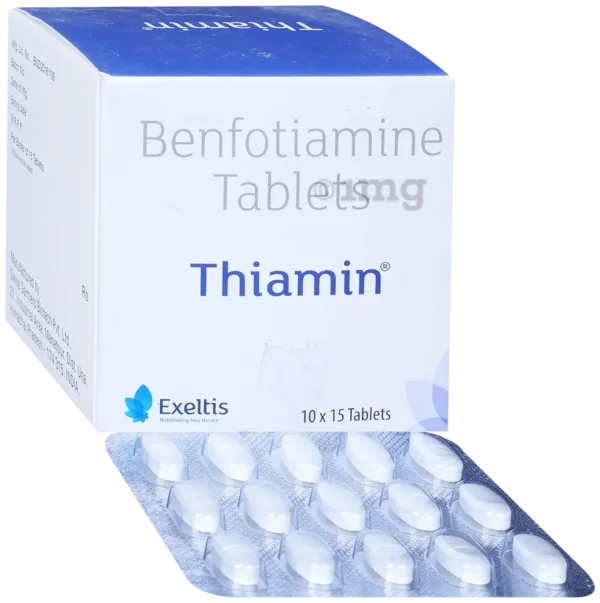
Yes, in most cases tab thiamine and thiamine hydrochloride tablet mean the same product. Thiamine hydrochloride, or thiamine HCl, is the salt form of vitamin B1 used in most tablets because it dissolves well. Be careful with the name "Thiamin" on a strip: some products sold under it are reported to be benfotiamine, a different salt, so it may not mean thiamine hydrochloride. Check the salt named on the label.
Is there a thiamine 200 mg tablet?
No source describes a thiamine 200 mg tablet. The 200 mg products found were injections, which a healthcare professional gives. This rests on trade listings only, so it is not a rule for all of India. If your prescription mentions 200 mg, ask your doctor or pharmacist which form they mean before you buy anything, so you get the right product.
Which brands sell thiamine hydrochloride tablet IP 100 mg in India?
Thiamine hydrochloride 100 mg tablets are sold in India under brands such as THIAMEAL ADD 100 from Steris Healthcare and THI-B1 from Johnlee, and by Icon Pharmaceuticals. Trumac Healthcare and Healthy Life Pharma also make thiamine tablets. Use whichever brand your doctor prescribes for you.
Do I need a prescription for thiamine tablets in India?
Prescription status is not settled in India. Some listings show the 100 mg tablet as prescription-only, another lists it as over the counter, and no CDSCO statement on its schedule was found. The references advise taking it under a doctor's supervision rather than starting it on your own.
What is the thiamine dose for children?
A healthcare provider decides the thiamine dose for a child. Reference amounts for supplementation are 0.3 to 0.5 mg once daily for infants and 0.5 to 1 mg once daily for children. These are far below a 100 mg tablet, so do not give an adult tablet to a child without medical advice.
What if I miss a dose of thiamine tablet?
Take the missed dose as soon as you remember. If your next dose is almost due, skip the missed one and carry on with your usual schedule. Do not take two doses together to make up for it, and speak to your doctor if you miss doses often.
How do I store thiamine tablets in Indian heat and humidity?
Keep the tablets below 30 °C in a dry place, away from heat, moisture and light, and do not freeze them. In humid weather, keep the strip closed and out of the bathroom. The listed shelf life is 24 months. Throw away expired tablets and keep the pack away from children.
References
- How and when to take thiamine – NHS. nhs.uk. Accessed 3 Nov 2026
- Thiamine 100mg tablet Uses, Benefits, and Dosage Guide | STERIS HEALTHCARE PVT LTD – ,Bhagalpur. sterispharma.com. Accessed 3 Nov 2026
- Thiamine Uses, Side Effects & Warnings. drugs.com. Accessed 3 Nov 2026
- Thiamine (Vitamin B1) : MedlinePlus Drug Information. medlineplus.gov. Accessed 3 Nov 2026
- Thiamine: uses, dosing, warnings, adverse events, interactions. medcentral.com. Accessed 3 Nov 2026
- Thiamine: Key Safety & Patient Guidance. drugs.com. Accessed 3 Nov 2026
- Thiamine Dosage Guide + Max Dose, Adjustments – Drugs.com. drugs.com. Accessed 3 Nov 2026
- Thiamine: Uses, Side Effects, Dosage & Interactions. apollohospitals.com. Accessed 3 Nov 2026
- Thiamine: Side Effects, Uses, Dosage, Interactions, Warnings. rxlist.com. Accessed 3 Nov 2026
- vitamin B1 (thiamine) dosing, indications, interactions, adverse effects, and more. reference.medscape.com. Accessed 3 Nov 2026
About this page
Written by: Mr. Neeraj Kumar, Bachelor’s Degree
Updated on: 3 Nov 2026
Product information: Product details come from the pack label, the manufacturer and published regulatory records, and are checked against the sources listed on this page before publishing. Read our editorial policy.
Disclaimer: Product information is provided for reference and does not replace advice from your doctor or pharmacist. Prescription medicines are supplied only against a valid prescription. Do not start, stop or change any medicine without medical advice. Prices and availability can change.
Marketer details: Manufactured by Trumac Healthcare makes thiamine 100 mg tablets under WHO-GMP-certified conditions for PCD franchise supply; Healthy Life Pharma also manufactures thiamine tablets (marketer/manufacturer pages, marketing-grade)