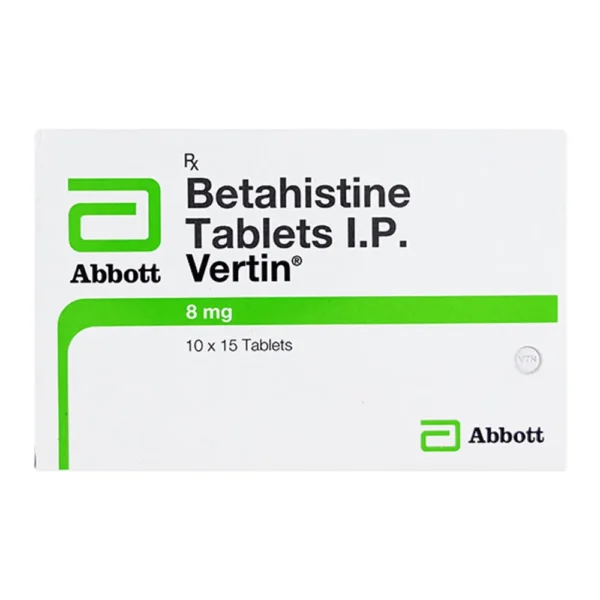
Vertin is a prescription tablet used in the treatment of Meniere's disease. Its only active ingredient is betahistine, sold as 8 mg and 16 mg tablets in packs of 15. It acts on histamine H1 and H3 receptors, and with regular use it may reduce how often attacks happen. You need a prescription to buy it.
Composition: Each uncoated 16 mg tablet contains betahistine hydrochloride I.P. 16 mg, with excipients q.s.
Marketer: The 16 mg tablet (15's) is marketed by Abbott Health Care Private Limited
Prescription: Prescription required · the 8 mg strength is listed as a Schedule H prescription drug
Key facts about Vertin
Here is the short version: one active ingredient, two strengths, a pack of 15 and a prescription needed.
| Key fact | Details |
|---|---|
| Composition | 16 mg strength: each uncoated tablet contains betahistine hydrochloride I.P. 16 mg, with excipients q.s. |
| Therapeutic class | The 8 mg strength is classified under the Central Nervous System therapeutic category |
| Strength, form and pack | 8 mg tablet: 8 mg betahistine · 16 mg tablet: 16 mg betahistine · Pack of 15 tablets |
| Marketer | The 16 mg tablet (15's) is marketed by Abbott Health Care Private Limited |
| Manufacturer | Manufactured by Abbott India |
| Prescription status | Prescription required · the 8 mg strength is listed as a Schedule H prescription drug |
About Vertin
Vertin is a single-ingredient medicine, not a combination. Everything it does comes from betahistine.
The 8 mg tablet holds 8 mg of betahistine. Each uncoated 16 mg tablet holds 16 mg of betahistine hydrochloride. Both come in strips of 15. Abbott India manufactures the tablets, and Abbott Health Care Private Limited markets the 16 mg strength.
Doctors prescribe it for Meniere's disease, and treatment can run for several months. Keep going with the full course even once you feel better.
How soon it helps: Some people notice a difference within a few weeks. The full benefit may take months.
Stopping: Don't stop suddenly without speaking to your doctor first, as your symptoms can come back worse.
Uses of Vertin
This medicine is used to treat Meniere's disease and the symptoms that come with it.
- Meniere's disease
- Symptomatic treatment of vertigo, tinnitus, nausea and hearing loss in Meniere's disease (16 mg strength)
Benefits of Vertin
Taken regularly, Vertin may cut down how often Meniere's attacks happen.
What it won't do: It may not stop attacks completely. It also does not work for an acute vertigo attack that has already begun, so it is a regular treatment rather than a quick fix during a spell.
How Vertin works
It works through histamine receptors. Betahistine is a histamine analogue: it partly activates H1 receptors (a partial agonist) and blocks H3 receptors (an antagonist).
It is also said to widen the blood vessels in the inner ear. That helps ease the pressure built up by excess fluid there.
Side effects of Vertin
The most common side effects are headache and stomach upset, and they are usually mild and pass on their own. Skin rash, itching, swelling of the face, tongue or throat, or difficulty breathing needs immediate medical attention.
Common side effects:
- Headache
- Nausea
- Indigestion (dyspepsia)
- Stomach discomfort
- Bloating
- Vomiting
- Stomach pain
- Dry mouth
Get medical help right away if: you develop a skin rash, itching, swelling of the face, tongue or throat, or difficulty breathing after a dose.
How to take Vertin
Take Vertin exactly as your doctor has prescribed it. These are the basics:
- Swallow the tablet whole with water. Don't crush or chew it.
- You can take it with or without food, but after a meal is better, as it helps prevent stomach upset.
- Adults (16 mg strength): the usual starting dose is 8 mg to 16 mg three times a day. Your doctor may adjust this based on how you respond and how severe your symptoms are.
Missed dose: Take it when you remember, unless your next dose is almost due. Never double up.
Overdose: Too much can cause nausea, abdominal pain, sleepiness, vomiting, fits, poor balance or coordination, and lung or heart complications. Contact a doctor immediately or go to the nearest hospital.
Safety advice for Vertin
Most of the cautions come down to pregnancy, breastfeeding, driving during dizzy spells, and kidney or liver problems. Here is each one at a glance.
- Alcohol — Consult your doctor. How alcohol interacts with betahistine is unknown. Check with your doctor before you drink.
- Pregnancy — Caution. Not recommended during pregnancy, as there isn't enough safety information. Use it only if your doctor advises it.
- Breastfeeding — Caution. Not recommended while breastfeeding unless it is necessary and your doctor advises it.
- Driving — Caution. It generally doesn't cause drowsiness, but vertigo can slow your reactions and upset your balance. Don't drive during a dizzy spell or if you feel unwell.
- Kidney — Consult your doctor. Tell your doctor if you have kidney problems, as your dose may need adjusting.
- Liver — Caution. If you have liver problems, use it carefully and under medical supervision.
Who should not take Vertin
Avoid it if you are allergic to betahistine or have phaeochromocytoma. Several other groups should use it only with extra care.
Allergy to betahistine: Don't take it if you are allergic to betahistine or any other ingredient in the tablet.
Phaeochromocytoma: Not recommended if you have phaeochromocytoma, an adrenal tumour that causes high blood pressure. The medicine may trigger the tumour to release chemicals.
Asthma, peptic ulcer or severe gastric problems: If you have asthma, a past peptic ulcer or severe gastric problems, use it carefully under medical supervision.
Children and teenagers under 18: Not advised for anyone below 18 years of age.
Adults above 75 years: Use with caution and under a doctor's guidance.
Pregnancy and breastfeeding: Not recommended during pregnancy because relevant safety information is lacking, and not recommended while breastfeeding unless necessary.
Kidney or liver problems: With kidney problems, speak to your doctor, as the dose may need to change. With liver problems, use it with caution and under medical supervision.
Interactions with Vertin
Tell your doctor if you take selegiline, an antihistamine or an MAO inhibitor, as these can affect how Vertin works.
- Selegiline: slows the breakdown of betahistine, which can raise its levels in your body. This may cause headache, flushing or low blood pressure.
- Antihistamines: may interact with betahistine, and both medicines may stop working properly.
- MAO inhibitors: let your doctor know if you take one before you start treatment.
FAQs about Vertin
What is the difference between Vertin 8 mg and Vertin 16 mg?
The difference is how much betahistine each tablet carries: the 8 mg tablet has 8 mg and the 16 mg tablet has 16 mg. For adults, the usual starting dose is 8 mg to 16 mg three times a day. Your doctor may adjust it depending on how you respond and how severe your symptoms are.
Vertin khana khane ke pehle lein ya baad mein?
You can take it with or without food, but after a meal is the better choice because it helps prevent stomach upset. Swallow the tablet whole with a glass of water, and don't crush or chew it. Stick to the timings your doctor has given you, and keep them as regular as you can.
Does Vertin make you sleepy?
It generally does not cause drowsiness. Vertigo itself is a different matter, though. A dizzy spell can throw off your balance and slow your reaction times. So even if the tablet doesn't make you feel sleepy, avoid driving while you feel dizzy and wait until the spell has fully passed.
Can I drink alcohol while taking Vertin?
The interaction between alcohol and betahistine is unknown, so there is no clear answer either way. That is why it makes sense to ask your doctor before you drink while on this medicine. Your doctor can look at your health and any other medicines you take, and advise you on what suits you.
What should I do if I miss a dose of Vertin?
Take the missed tablet as soon as you remember. If your next dose is almost due, skip the one you missed and carry on with your usual schedule. Never take two doses together to make up for a missed one, as doubling up does not help and is not advised.
What happens if someone takes too many Vertin tablets?
Taking too much may cause nausea, stomach pain, sleepiness, vomiting, fits, poor balance or coordination, and lung or heart complications. If you think someone has taken more than prescribed, don't wait for symptoms to appear. Contact a doctor immediately or go to the nearest hospital straight away.
About this page
Written by: Mr. Neeraj Kumar, Bachelor’s Degree
Updated on: 3 Nov 2026
Product information: Read our editorial policy.
Disclaimer: Product information is provided for reference and does not replace advice from your doctor or pharmacist. Prescription medicines are supplied only against a valid prescription. Do not start, stop or change any medicine without medical advice. Prices and availability can change.
Marketer details: Marketed by Vertin 16 mg tablet 15's is marketed by Abbott Health Care Private Limited, manufactured by Manufactured by Abbott India.